Designing Oil on Canvas: making dense art history approachable
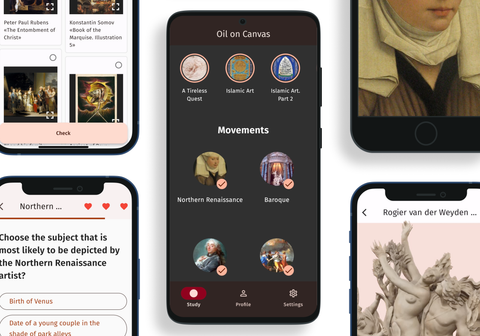
I founded Oil on Canvas and led it from the initial product idea through research, UX/UI design, development, monetization, and release. The product turned art history into short lessons, visual questions, stories, flashcards, and interactive artwork exploration across iOS, Android, tablets, and web.
———
- Role
- Founder & Product Designer
- Period
- 2021–2023 active development
- Ownership
- Product strategy, research, UX/UI, development, and business
- Scale
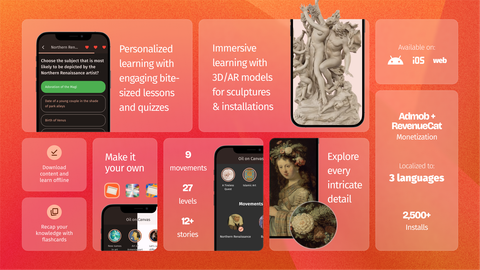
- iOS, Android, tablets, and web · 27 levels · 9 movements · 12+ stories · 3 languages · 2,500+ installs
The challenge: make art history approachable without flattening it
Art history is often presented through long lectures, academic texts, and courses that require substantial time and prior knowledge. That makes it difficult to approach casually, especially on a mobile device.
The challenge was not simply to shorten the material or turn it into trivia. I needed to divide dense subjects into manageable interactions without removing the historical context that made them meaningful.
My direction was inspired by the accessibility of Duolingo-style learning: short sessions, visible progress, immediate feedback, and enough variety to encourage people to return.
My role: founder and product designer
I was the main founder and owned the product from idea to release. I led product strategy, competitor analysis, usability testing, UX and visual design, Flutter development, budgeting, monetization, pitch materials, and business decisions.
I worked with a content manager and primary writer, translators, and a freelance art historian. A backend and DevOps contributor supported focused infrastructure, deployment, testing, and performance work in the CMS.
Throughout development, I combined usability testing with App Store and Google Play reviews, Firebase data, and Google Analytics. I used these signals to refine navigation, lesson progression, question formats, and the balance between structured learning and casual discovery.
Turning a broad subject into a repeatable learning loop
I organised the curriculum into a clear hierarchy:
Movements — individual movement — sequenced levels — theory and quiz screens
For example, a user could open Impressionism, begin with an introduction, and continue through progressively more detailed levels.
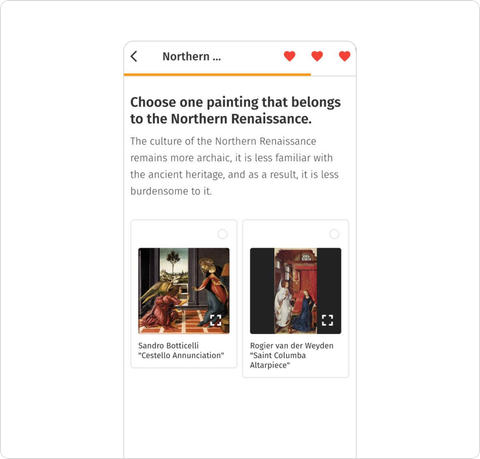
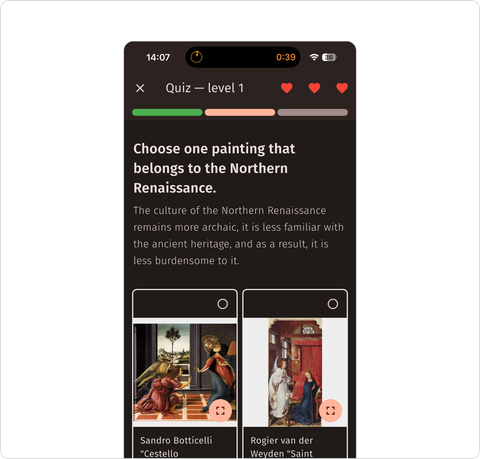
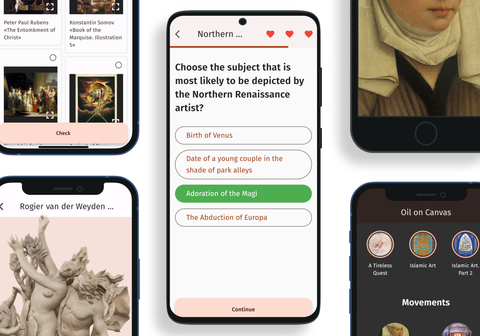
Inside each level, the experience alternated between a short piece of theory and one focused question. Questions could use text or paintings as answers. Immediate feedback kept the interaction moving, while progress was saved between sessions and completed material could later be reviewed through flashcards.
This structure allowed the product to explain a subject gradually instead of presenting a long article followed by a large final test.
Two modes for different levels of commitment
A structured curriculum still requires commitment, so I designed Stories as a parallel way to explore the subject.
Stories used familiar tap-through interactions to present short pieces about artists, museums, individual works, techniques, and other art-related topics. They were independent from the main progression, allowing someone to open the app and learn something without starting a full level.
The product therefore supported two complementary modes:
- Structured learning through movements and sequential levels;
- Casual discovery through short, self-contained Stories.
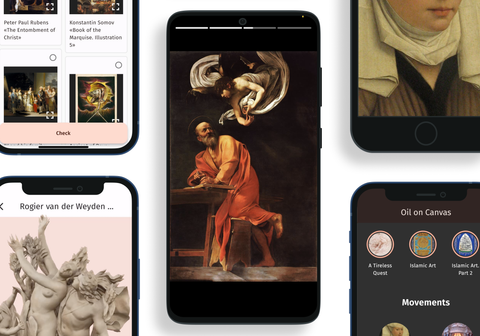
Letting users examine the artwork, not just read about it
Reducing the amount of text did not mean reducing the artwork itself. Images needed enough space and fidelity for users to examine composition, colour, and small details.
I designed a high-resolution viewer that allowed people to zoom into paintings rather than treating them as static quiz thumbnails.
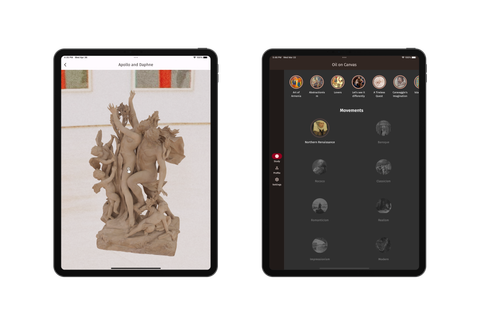
When a lesson introduced a sculpture, users could rotate its 3D model inside the learning experience. Supported models could also be placed in their surroundings through augmented reality. These interactions appeared where examining the physical form added something that text or a flat image could not provide.
Designing the content operation behind the interface
Oil on Canvas launched in English, Russian, and Ukrainian. The released curriculum included 27 levels across 9 art movements, alongside more than 12 Stories.
To support the writers, translators, and art historian, I built an administrative CMS for managing lessons, question types, media, localization, and publishing. The content model had to remain flexible enough for different interactions while staying predictable for the people producing the material.
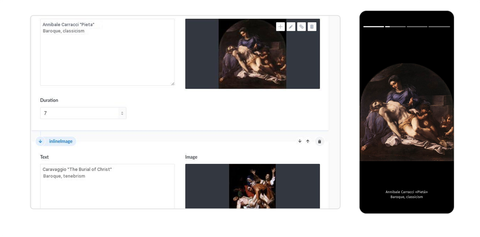
I also designed and developed phone and tablet layouts, a Flutter Web version, and a separate marketing website. The marketing site used playful quizzes connecting art history with films, music, internet culture, and everyday interests, creating another entry point into the product.
Monetization without interrupting learning
The free version was supported by advertising, but I did not want ads to interrupt the learning loop. Interstitial ads appeared only after completing a level or selected Stories—not between a theory screen and its question.
The subscription removed advertising and added offline learning, exclusive content, and alternative application icons. This created a paid tier without deliberately making the free learning experience unpleasant.
Shipped scope and outcome
Oil on Canvas shipped on the App Store and Google Play for phones and tablets, with an additional web version. It reached approximately 1,125 Android installs and 1,400 iOS installs—more than 2,500 combined.
The delivered product included:
- 27 learning levels across 9 art movements;
- more than 12 Stories;
- English, Russian, and Ukrainian localization;
- text- and image-based questions, progress, and flashcards;
- high-resolution artwork viewing and interactive 3D/AR content;
- subscriptions, restrained advertising, authentication, notifications, and analytics;
- phone, tablet, and web experiences;
- an administrative CMS and quiz-led marketing website.
Oil on Canvas remained a side project rather than becoming a large commercial product. Active development ended in 2023, followed by occasional maintenance. I later retired the original infrastructure and migrated the remaining application content and storage to Firebase.
What I learned
Building Oil on Canvas gave me direct responsibility for more than its interface. Content structure, interaction design, localization, monetization, infrastructure, and acquisition all affected one another.
Looking back, I would validate retention in the central lesson-and-quiz loop earlier, before investing in adjacent experiences such as Stories, AR, and the marketing website. That experience changed how I approach early-stage products: establish the smallest valuable recurring behaviour, measure it, and expand when the evidence supports it.